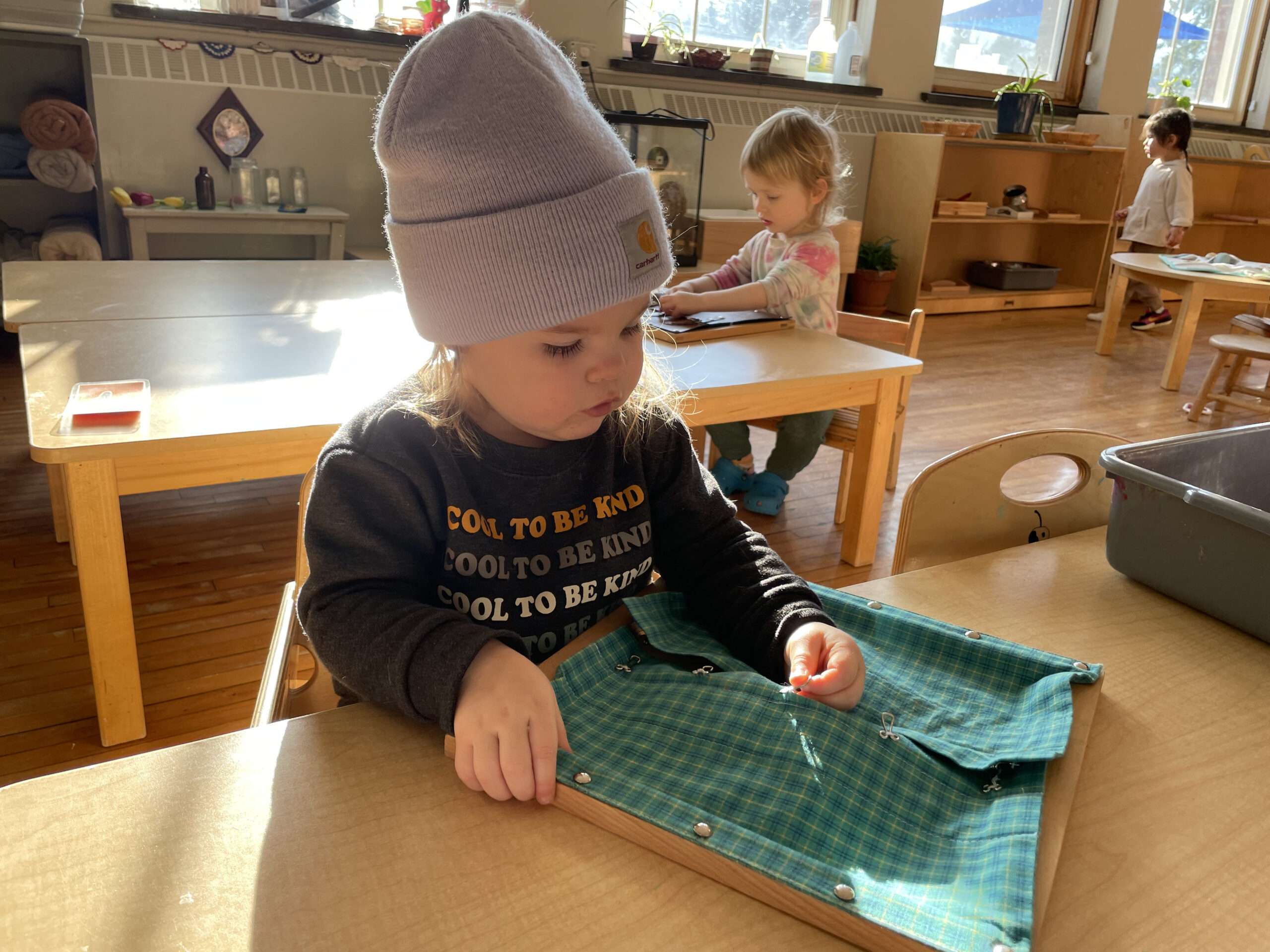
Many Rivers follows the educational method first developed by Dr. Maria Montessori in 1907 that is now one of the most widely practiced pedagogies in the world. Based in scientific observation and deep respect for children’s natural development, Montessori pedagogy gives children the freedom to explore and develop to their fullest potential. The concept of respect—for self, others, and environment—guides the Montessori method.
Every room in a Montessori school is prepared to meet the developmental needs of the age group served within that learning environment. Furniture and materials are designed for the child’s appropriate physical and psychological needs. A prepared environment includes a full range of Montessori materials, a trained Montessori lead teacher (guide), and an assistant teacher.

Montessori designed her materials specifically to assist in the child’s growth in the areas of practical life, sensorial, mathematics, language arts, music, art, science, history and geography. The materials are not toys–they are self-correcting educational implements that children are introduced to when the guide observes a child’s readiness. While working with the materials, each child learns to concentrate, develop self-confidence, respect themselves and others, understand order, and establish a love of learning.
Many Rivers Montessori believes that each individual child, and not the adults in the classroom, is at the center of their own learning process. The guide’s role in the classroom is to observe all the children in the community and base lessons and learning plans on these observations. These observations, objectively done with careful note-taking, allow the guide to know and advocate for each child as they progress through the different stages of human development.
Montessori philosophy says that every human being possess the following needs and tendencies:
- The need to communicate and use language
- The need to organize and classify
- The need for independence and activity
- the drive for purposeful and constructive work
- The need for social relationships
The guide helps each child to make choices for purposeful and meaningful work, helping the children reach their fullest potential by leading them to work that meets their developmental needs and current interests. This often happens through spontaneous individual and group lessons in the environment. Three-hour periods of uninterrupted work daily provide children with time to dive into big work and concentrate on what they need to complete a task.
Multi-aged learning communities are a cornerstone of the Montessori method. Younger children are well served as the older children act as role models and mentors; older children are well served by gaining perspective on their own natural growth and development within the three-year cycle. This setup creates a strong sense of belonging, community, and interdependence.
The trained guides and assistants, prepared environment, Montessori materials, and the children together create an AMI Montessori community. The result is a child growing in a strong self-image, a sense of self-esteem, and a feeling of belonging. Finding their needs met in this way, the child cultivates the traits of respect, learning and exploration that will last a lifetime.